If you’re a non-religious parent, you’ve probably heard the concern: “But how will they know right from wrong?” Or maybe it’s the slightly more anxious version you ask yourself late at night: “Am I doing them a disservice by raising them outside a faith community?”
These are fair questions. And the good news is that researchers have been studying them seriously for decades. The results might surprise you — and they’ll almost certainly reassure you.
Here’s what the science actually says about raising kids without religion.
First, How Many Secular Kids Are There?
More than you might think. According to Pew Research, the number of religiously unaffiliated Americans — often called “nones” — has grown steadily over the past two decades. A significant portion of those adults are now raising children outside of any religious tradition.
This isn’t a fringe phenomenon. It’s one of the most significant demographic shifts in modern American life, and researchers have taken notice.
Do Non-Religious Children Turn Out Okay? (Spoiler: Yes)
This is the big one. A landmark 2015 study published in Current Biology examined over 1,000 children from six countries — the US, Canada, China, Jordan, Turkey, and South Africa — and found that children raised in non-religious households were actually more altruistic than their religious peers, not less.
The children in the study were asked to share stickers with anonymous others. Non-religious children shared more, on average, than religious children did. They were also less likely to endorse harsh punishment for perceived transgressions.
None of this means religious upbringings produce worse outcomes. The research is nuanced. But it does firmly put to rest the idea that a secular childhood is in any way a deficient one.
What About Morality?
This is where secular parents get challenged most often, and it’s where the research is perhaps most interesting.
Children don’t need religious instruction to develop a moral compass. Developmental psychologists have known for some time that humans are born with a rudimentary sense of fairness, empathy, and harm — it’s baked into our social nature as a species. A baby will reach for a “helpful” puppet over a “hindering” one long before they can understand any moral framework, religious or otherwise.
What secular parents can offer is explicit moral reasoning — teaching children why certain behaviors are right or wrong, rather than grounding ethics in divine command. Research suggests this approach produces children who are better at moral reasoning in novel situations, because they’ve been taught to think through principles rather than defer to rules.
Philosopher and psychologist Steven Pinker and others have argued that secular moral frameworks — grounded in empathy, reciprocity, and reason — are actually more robust over time precisely because they require active engagement rather than passive acceptance.
The Community Question
Here’s where secular parenting gets genuinely harder, and it’s worth being honest about it.
Religious communities provide something powerful: a ready-made social network, shared rituals, a sense of belonging, and structured rites of passage. This is one of the main reasons many non-believing parents still take their kids to church — the community benefits are real.
For secular families, building that sense of community requires more intentionality. The good news is that options are growing:
- Sunday Assembly — often called “atheist church,” with chapters in cities across the US and UK
- Humanist communities affiliated with the American Humanist Association
- Secular Student Alliance for older kids and teens
- Camp Quest — a network of secular summer camps with a growing presence across North America
- Local skeptics and freethinkers meetups — check Meetup.com for groups near you
The community infrastructure for secular families is still catching up to what organized religion offers, but it’s growing fast.
Rituals and Meaning Without Religion

One concern secular parents often raise is this: religion provides structure, ceremony, and meaning at key life moments — birth, coming of age, marriage, death. What do non-religious families do instead?
Quite a lot, it turns out.
Many secular families create their own rituals — annual traditions, family values statements, celebrations tied to nature and the seasons rather than religious calendars. The winter solstice, for example, is celebrated by many secular families as a grounded, scientific marker of the year’s turning.
Secular humanist coming-of-age ceremonies are becoming more common, modeled loosely on the concept of a bar or bat mitzvah — a moment where a young person demonstrates their values and their readiness to engage with the world as a thoughtful adult.
The key insight from psychological research on ritual is that the content of rituals matters less than their consistency and intentionality. Repeated, meaningful family practices — whatever they are — provide children with exactly the kind of psychological grounding that religious rituals are often credited with providing.
How to Talk to Kids About Religion Itself
Most non-religious parents don’t raise their kids in a bubble. Children will have religious friends, attend religious events, and ask questions. How you handle those conversations matters.
Most child development experts recommend an approach of curious openness rather than dismissal. This means:
- Explaining what different religions believe, factually and respectfully
- Making clear that many people find real meaning and comfort in faith
- Sharing your own values and reasons for living without religion honestly, in age-appropriate ways
- Encouraging questions and sitting with uncertainty together
This approach does two things. It models the intellectual humility and curiosity you want to instill, and it avoids setting up a dynamic where religion becomes forbidden fruit — something that can backfire sharply in adolescence.
What Non-Religious Kids Tend to Have Going for Them

Research and anecdotal evidence from secular parenting communities suggest a few consistent strengths:
- Comfort with uncertainty. Kids raised without religion tend to be more comfortable saying “I don’t know” and sitting with open questions — a trait that correlates strongly with scientific thinking and intellectual resilience.
- Intrinsic moral motivation. Because their ethics aren’t grounded in reward and punishment from a divine authority, secular kids often develop a stronger sense of doing right because it’s right.
- Critical thinking skills. Secular households tend to model questioning, evidence-seeking, and skepticism as positive values.
- Openness to diversity. Studies show non-religious children tend to be more accepting of people from different backgrounds and belief systems.
The Bottom Line
Raising kids without religion is not a deprivation. It’s a choice — and a growing body of research suggests it’s one that produces thoughtful, ethical, happy people who are more than capable of living meaningful lives.
The challenges are real: community requires more effort, rituals require more creativity, and conversations about death and meaning require more directness. But for many families, those challenges are also opportunities — to build something intentional, to model reasoning and empathy in action, and to raise children who’ve thought hard about what they believe and why.
That’s not a lesser childhood. That’s a pretty remarkable one.
At Rational Supply Co., we sell and promote clothing and gifts for exactly these families — people who are proud of their secular values and want to wear them. Browse our collection and find something that fits.
Further Reading
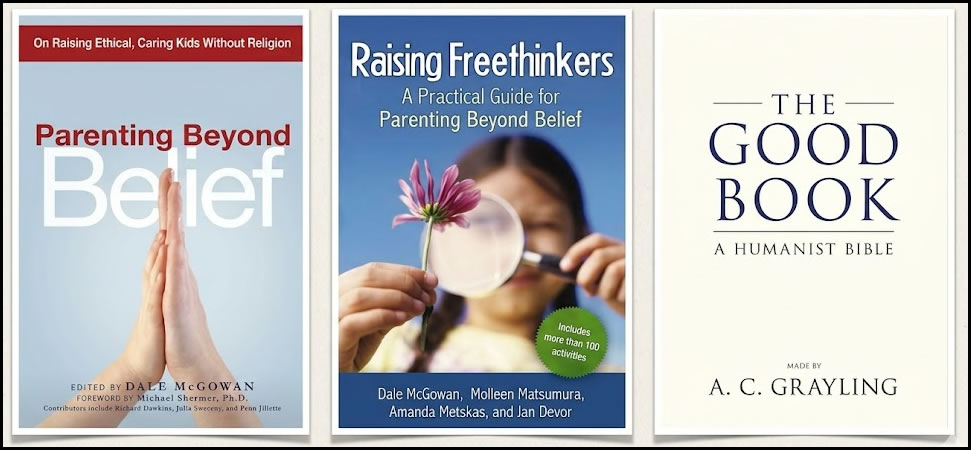
- Parenting Beyond Belief: On Raising Ethical, Caring Kids Without Relgion by Dale McGowan
- Raising Freethinkers? A Practical Guide for Parenting Beyond Belief by Dale McGowan, Molleen Matsumara, Amanda Metskas & Jan Devor
- The Good Book: A Humanist Bible by A.C. Grayling