
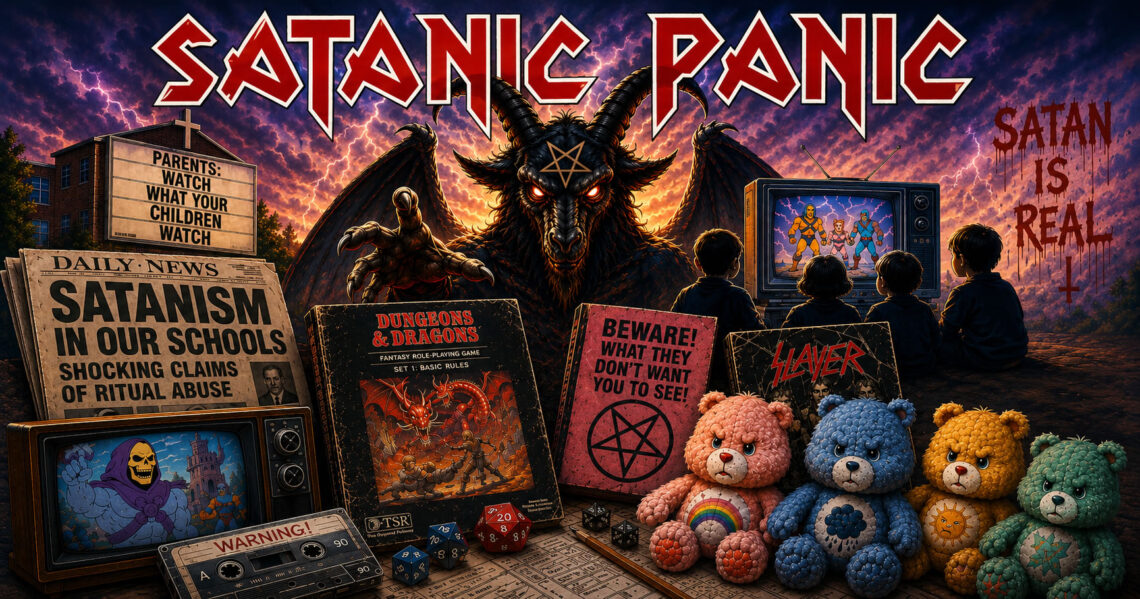
If you grew up in an evangelical household in the 1980s, there’s a good chance your parents were absolutely certain that Satan had infiltrated Saturday morning cartoons, the school library, the local toy store, and — most urgently — your record collection. The decade was gripped by what historians now call the Satanic Panic: a widespread moral panic, centered primarily in American Christian communities, that held that occult forces were quietly corrupting children through the media they consumed every day.
Looking back, it was one of the most entertainingly creative periods in the history of religious anxiety — a time when a Ouija board at a slumber party was treated with roughly the same alarm as a loaded weapon, and when perfectly reasonable adults convinced themselves that Mister Rogers’ Neighborhood was spiritually suspect. Let’s take a tour.
How It Started (Or: Blame the Bestseller List)
The Satanic Panic didn’t erupt from nowhere. It was fertilized by a very particular cultural moment — the rise of televangelism, the culture wars of the Reagan era, and a general sense among conservative Christians that secular culture was getting out of hand and taking the kids with it.
A major accelerant was the 1972 book The Satan Seller by Mike Warnke, a self-described former Satanic high priest who claimed to have witnessed all manner of dark ritual before finding Jesus. The book sold widely in Christian circles and established a template: Satanism wasn’t just a theological abstraction, it was an organized, active network recruiting America’s youth.
Add to that a flood of similar testimonies, sensationalist TV news segments, and the occasional panicked school board meeting, and you had the ingredients for a full-blown moral panic. All it needed was a target list.
The Usual Suspects
The 1980s produced what might be the most eclectic hit list of supposed Satanic influences in history. Among the accused:
Dungeons & Dragons. The tabletop roleplaying game was Exhibit A for concerned parents everywhere. The reasoning: it involved magic, demons, and spells, therefore playing it was essentially practicing occultism. The fact that it was also just a bunch of teenagers sitting around a table rolling dice and arguing about treasure was considered irrelevant. A 1982 TV movie called Mazes and Monsters — starring a young Tom Hanks — dramatized the “dangers” of the game, which probably did more for D&D’s coolness than anything the game’s creators could have managed.
Heavy Metal Music. Ozzy Osbourne, Black Sabbath, KISS (rumored to stand for “Knights In Satan’s Service,” a claim the band denied but found endlessly amusing) — the imagery was dark, the volume was loud, and that was basically enough. Churches held vinyl-burning events. Parents confiscated cassette tapes. Teenagers largely found this deeply satisfying.
Cartoons. Here is where things get genuinely surreal. He-Man and the Masters of the Universe was flagged for its sorcery themes. The Smurfs apparently dabbled in magic. Dungeons & Dragons had its own Saturday morning cartoon, which was basically a direct provocation. Even the Care Bears, those pastel harbingers of hugging and sharing, were accused of promoting New Age spirituality. The Care Bears. Tenderheart Bear was apparently a gateway drug to the occult.
Toys. The Ouija board has been a Parker Brothers product since 1890, but in the 1980s it graduated from “spooky game” to “literal portal to demonic forces.” Cabbage Patch Kids were rumored — in some circles — to cast spells on children who played with them. The proof was generally “someone’s cousin said so.”
Rock solid proof that Monster energy drinks are from Satan
Backward Masking: The Devil in the B-Side
Of all the era’s panics, backward masking is perhaps the most analytically fascinating — and the most revealing about how motivated reasoning works in practice.
The claim went like this: rock musicians were embedding Satanic messages in their recordings, audible only when the record was played in reverse. The idea got a serious boost in 1982 when the California State Assembly actually held hearings on the subject, and the Parents Music Resource Center later pushed the issue into national conversation.
The accused included some of the biggest names in rock. Led Zeppelin’s “Stairway to Heaven,” when reversed, supposedly yielded the phrase “Here’s to my sweet Satan.” The Beatles’ “Revolution 9” played backward allegedly said “Turn me on, dead man.” Judas Priest faced a wrongful death lawsuit in 1990 from families who claimed the phrase “do it” was hidden in the song “Better By You, Better Than Me,” subliminally encouraging two teenagers to attempt suicide.
The scientific problem with all of this is significant. Psychologists have a term for what was actually happening: apophenia, the tendency of the human brain to find meaningful patterns in random noise. When you tell someone there’s a hidden message in reversed audio and then play it for them, they hear the message — not because it’s there, but because the brain is extraordinarily good at finding what it’s been primed to find. In controlled studies, people who were told what to listen for “heard” the messages. People who weren’t told heard gibberish.
The additional practical problem: recording a deliberate backward message that also sounds like a coherent forward song is technically complicated and time-consuming. The idea that Robert Plant was spending his studio time meticulously layering Satanic content into the B-section of a rock ballad — content audible only to people with a turntable and too much free time — requires a significant leap of faith. Ironically.
apophenia
the tendency to perceive a connection or meaningful pattern between unrelated or random things
What Was Really Going On

Moral panics follow a fairly predictable structure, and the Satanic Panic was a textbook case. A society experiencing rapid cultural change produces anxiety. That anxiety looks for an external cause. A network of concerned voices — in this case, pastors, Christian television, and a steady stream of self-proclaimed ex-Satanists doing the church circuit — provides a narrative framework that explains the anxiety and identifies the enemy.
The 1980s were genuinely disorienting for a certain kind of American family. MTV was new. Video games were new. The culture was moving fast in directions that felt alien. The Satanic Panic gave that free-floating unease a name and a face — and conveniently, the face was on your kid’s bedroom shelf wearing a Black Sabbath t-shirt.
It’s also worth noting that the panic had real victims. The McMartin preschool trial — one of the longest and most expensive criminal trials in American history — resulted from accusations of Satanic ritual abuse at a California daycare that were eventually found to be entirely without basis. Families were destroyed. Innocent people lost years of their lives. The “Satanic ritual abuse” scare of the 1980s and early 90s, fed by therapists using since-discredited suggestive interview techniques, is a sobering reminder that this stuff wasn’t just funny — it had genuine human costs.
The Legacy: We Still Do This
The Satanic Panic largely faded by the mid-1990s, replaced by new panics about video game violence, internet predators, and eventually internet culture more broadly. The specific targets change; the underlying psychology doesn’t. Every generation finds its version of backward masking — its hidden threat lurking in the entertainment children love, waiting to be decoded by adults vigilant enough to look.
The 1980s version just had the distinction of being particularly convoluted in its imagination, and of leaving behind a truly magnificent paper trail of church bulletins, local news segments, and congressional testimony warning the nation about the spiritual dangers of the Care Bears.
A Closer Look
Seth Andrews, also known as The Thinking Atheist, released an amazing video several years ago of a talk he gave on the subject of the satanic panic. Check it out here, and be sure to give his channel a follow while you’re there. You won’t regret it.
At Rational Supply Co., we think the world is a lot more interesting when you’re not searching for the devil in the record collection. Browse our clothing, gifts, and accessories designed for freethinkers who’d rather ask questions than burn vinyl — and wear your skepticism with a little style.


JOhn Todd, Jack Chick “Dr.” Rebecca Brown.There were dozens of them.
Chick tracts were THE WORST.