“Evolution is just a theory.”
It’s one of the most common objections to evolution—and it sounds persuasive at first. After all, in everyday conversation a “theory” often means a guess, a hunch, or an idea that hasn’t been proven. If that’s what scientists mean, then evolution might seem like little more than an educated opinion.
But that’s not what scientists mean at all.
In science, a theory is one of the highest levels of scientific understanding. It isn’t a guess waiting to become a fact. It’s a comprehensive explanation supported by an enormous body of evidence that has survived repeated testing and successfully predicts new discoveries. Gravity, germs, plate tectonics, and evolution are all scientific theories in this sense.
The real question, then, isn’t whether evolution is “just a theory.” It’s why scientists across so many different disciplines—from biology and genetics to medicine, geology, and paleontology—rely on evolutionary theory every day. This article explores what a scientific theory really is, why evolution meets that standard, and why so much of modern science simply wouldn’t make sense without it.
What Scientists Mean by “Theory”
The word theory has two very different meanings depending on the context.
If someone says, “I have a theory about who stole the cookies,” they usually mean they’re making an educated guess. In everyday conversation, a theory is often little more than speculation.
Science uses the word very differently.
A scientific theory is a well-tested explanation that unifies a large body of evidence and accurately predicts future observations. According to the National Academy of Sciences, scientific theories are comprehensive explanations of natural phenomena that are supported by extensive evidence and are continually tested and refined as new data become available.
Many people have heard that theories eventually become laws once they’re proven. That’s another common misconception. Scientific laws and scientific theories serve different purposes. A law describes what happens under certain conditions. A theory explains why it happens.
For example, Newton described how gravity behaves with his law of universal gravitation. Einstein later developed the Theory of General Relativity, which explains gravity in terms of the curvature of spacetime. The law didn’t become a theory, and the theory didn’t replace the law—they answer different questions.
Evolutionary theory works the same way. It explains why living things share common features, why species change over time, and why life on Earth exhibits the patterns we observe today.
Evolution Is the Foundation of Modern Biology
The famous geneticist Theodosius Dobzhansky once wrote:
“Nothing in biology makes sense except in the light of evolution.”
That statement isn’t hyperbole.
Imagine trying to explain why humans, chimpanzees, whales, bats, and cats all have the same basic arrangement of bones in their forelimbs. Why do whales have finger bones hidden inside their flippers? Why do bats have elongated finger bones supporting their wings?
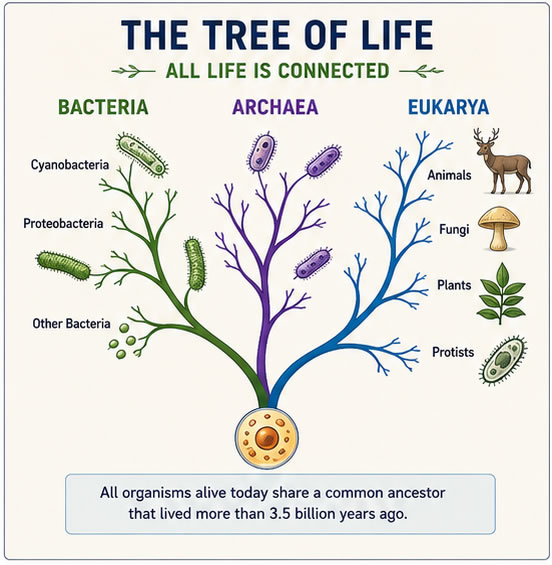
Evolution explains these similarities through common ancestry. Different species inherited the same basic skeletal structure from ancient ancestors and modified it over millions of years for different purposes.
The same principle appears throughout biology.
Why do humans share nearly all of their DNA with chimpanzees?
Why do whales still possess genes involved in producing hind limbs, even though they no longer have external back legs?
Why do many unrelated organisms use the same genetic code?
Without evolution, these observations appear disconnected. With evolution, they form a coherent pattern.
Rather than being a collection of isolated facts, biology becomes a unified science.
Medicine Uses Evolution Every Day
One of the biggest misconceptions is that evolution only concerns events that happened millions of years ago.
In reality, doctors, epidemiologists, and medical researchers observe evolution in real time.
Every time bacteria become resistant to antibiotics, evolution is occurring.
Every time influenza viruses change enough to require an updated seasonal vaccine, evolution is occurring.
Every time new variants of viruses emerge through mutation and natural selection, evolution is occurring.
Cancer itself evolves. Tumor cells accumulate mutations, and those best able to survive treatment continue reproducing. This evolutionary process helps explain why some cancers become resistant to chemotherapy and why treatments often need to change over time.
Researchers developing vaccines, antibiotics, and antiviral drugs routinely use evolutionary principles to understand how organisms adapt and how diseases spread.
Evolution isn’t simply an historical explanation.
It’s an essential tool in modern medicine.
The Fossil Record Matches Evolution’s Predictions
Critics sometimes imagine the fossil record as a random assortment of bones.
It isn’t.
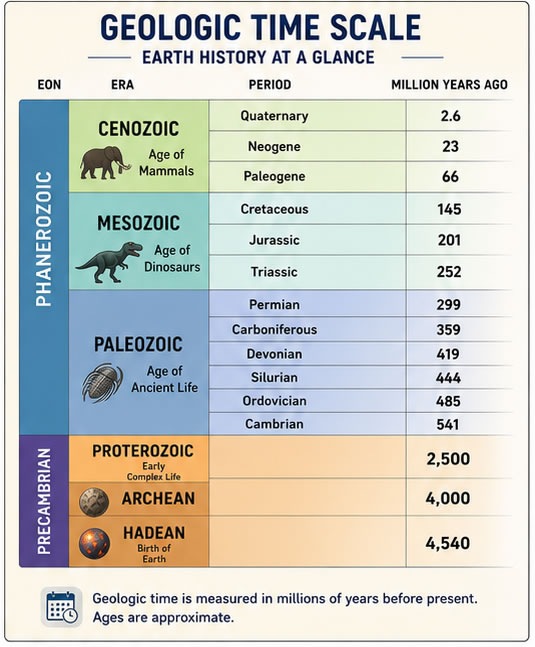
Fossils occur in a remarkably consistent chronological order.
Dinosaurs never appear alongside humans in geological strata.
Modern mammals never appear in rocks hundreds of millions of years older than mammals themselves.
Flowering plants don’t suddenly appear in the earliest geological layers.
Instead, organisms appear in an order that matches evolutionary relationships.
Scientists have also predicted where transitional fossils should exist before discovering them.
One famous example is Tiktaalik, an animal with characteristics of both fish and early land vertebrates. Based on evolutionary theory, paleontologists predicted fossils like Tiktaalik should be found in rocks approximately 375 million years old. They searched rocks of that age in Arctic Canada—and found exactly what they expected.
The fossil record isn’t perfect. Fossilization is rare, and many organisms never become fossils. Even so, the overall pattern consistently aligns with evolutionary predictions.
Geology Provides the Timeline
Evolution requires enormous spans of time.
Fortunately, geologists didn’t conclude Earth was ancient because of evolution.
They reached that conclusion independently.
By studying rock layers, radioactive decay, continental movement, and Earth’s geological history, scientists determined our planet is approximately 4.54 billion years old.
Radiometric dating uses the predictable decay of radioactive isotopes to determine the ages of rocks. Multiple independent dating methods consistently agree with one another, giving scientists confidence in Earth’s age.
Evolution fits naturally into this independently established timeline.
Without billions of years, many evolutionary changes would be difficult to explain.
With billions of years, the diversity of life observed today becomes understandable.
DNA Became Evolution’s Strongest Evidence
When Charles Darwin published On the Origin of Species in 1859, nobody knew DNA existed.
Today, genetics provides some of the strongest evidence supporting evolution.
Scientists can compare entire genomes across species.
The results consistently reveal nested patterns of similarity exactly as common ancestry predicts.
Humans share more DNA with chimpanzees than with gorillas.
Humans share more DNA with gorillas than with monkeys.
Humans share more DNA with monkeys than with mice.
This branching pattern repeats throughout life.
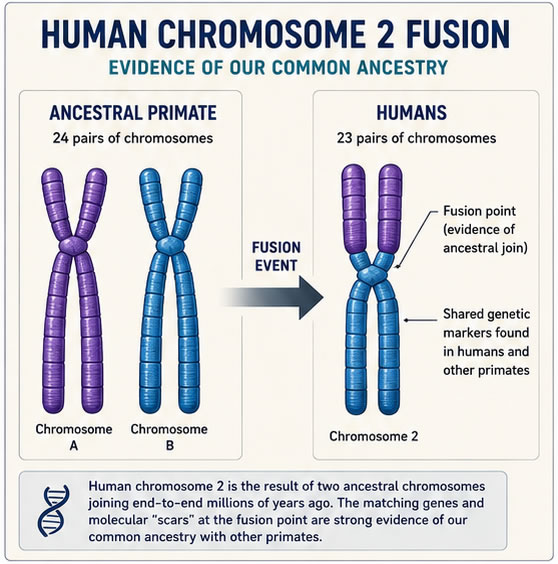
One particularly striking example involves human chromosome 2.
Humans have 23 pairs of chromosomes.
Chimpanzees, gorillas, and orangutans have 24.
Evolution predicted that one pair of ancestral chromosomes must have fused in the human lineage.
Later genetic research discovered precisely such a fusion.
Human chromosome 2 contains molecular signatures exactly where scientists expected two ancestral chromosomes to have joined together.
Discoveries like this illustrate one of science’s most powerful features: successful prediction.
Evolution didn’t merely explain evidence after the fact.
It predicted what scientists should find.
Then researchers found it.
Evolution Makes Testable Predictions
Good scientific theories don’t just explain existing evidence.
They make predictions that can be tested.
Evolutionary theory has repeatedly done exactly that.
It predicted:
- Transitional fossils should exist.
- Closely related species should share more DNA than distant relatives.
- Island species should resemble nearby mainland species.
- Vestigial structures should exist.
- Human chromosomes should contain evidence of ancestral chromosome fusion.
Each prediction was later supported through observation and research.
This predictive power is one reason evolutionary theory has remained central to biology for more than 165 years.
The same process applies to every successful scientific theory.
Scientists continually test predictions against observations.
When predictions consistently succeed, confidence in the theory grows.
Why Modern Science Depends on Evolution
Imagine removing evolution from science.
Medicine loses its framework for understanding antibiotic resistance and viral mutation.
Genetics loses its explanation for shared DNA and inherited traits.
Paleontology loses its framework for interpreting the fossil record.
Ecology loses much of its understanding of adaptation and biodiversity.
Agriculture loses important tools for breeding crops and managing pesticide resistance.
Biology itself becomes a collection of unrelated observations instead of a unified science.
This doesn’t mean evolution answers every question about life.
Science is always refining details, testing hypotheses, and improving explanations. Researchers continue debating the exact evolutionary relationships between species, the timing of evolutionary events, and the mechanisms driving particular adaptations.
But those ongoing debates occur within evolutionary biology—not over whether evolution itself provides the best explanation for the evidence.
That’s an important distinction.
Scientists argue about details because the broader framework has proven extraordinarily successful.
Conclusion
Calling evolution “just a theory” misunderstands what science means by the word theory.
A scientific theory isn’t a guess or an opinion. It’s a comprehensive explanation supported by extensive evidence, tested repeatedly, and continually refined as new discoveries are made.
Evolution has earned that status not because scientists are committed to Charles Darwin or because alternative ideas have been ignored. It has earned that status because it consistently explains observations from genetics, medicine, paleontology, geology, ecology, embryology, and countless other fields while successfully predicting new discoveries.
If tomorrow a different explanation accounted for all of this evidence more accurately and made better predictions, scientists would embrace it. That’s how science works.
More than 165 years after On the Origin of Species was published, however, discoveries in DNA sequencing, fossil research, geology, and medicine have repeatedly strengthened evolutionary theory rather than overturned it.
That is why evolution remains one of the best-supported scientific theories in all of science.
Further Reading
- National Center for Biotechnology Information (NCBI Bookshelf) – Evidence Supporting Biological Evolution
- American Association for the Advancement of Science (AAAS) – Resources on the nature of science
- Geological Society of America – Position statements and educational resources on evolution
- University of California Museum of Paleontology – Understanding Evolution