Were the Founding Fathers Christian? The short answer: some were, most weren’t — at least not in any orthodox sense. The longer answer is messier, more interesting, and more useful than either side of the culture war wants to admit.
The Founding Fathers held a wide range of religious views — from the conventionally devout to the deeply skeptical. The most influential among them, including Jefferson, Franklin, Adams, and Madison, were products of the Enlightenment who rejected supernatural Christianity in favor of reason-based deism. Understanding where they actually stood tells us a great deal about why they built the republic the way they did — and why the separation of church and state was a feature, not an accident.
First: What Was “Deism”?
To understand the religious views of many leading founders, you need to understand deism — the dominant intellectual framework for skeptical thinkers in the 18th century.
Deists believed in a creator God who set the universe in motion but did not intervene in human affairs. No miracles. No answered prayers. No divine revelation. God was more like a master clockmaker than a personal father — evident in the order and beauty of nature, but not available for conversation.
Deism was enormously influential among educated Europeans and Americans in the Enlightenment period. It allowed thinkers to reject the supernatural claims of organized religion while avoiding the social and legal risks of outright atheism. Many of the most important founders were deists in this sense — or held views close to it.
Thomas Jefferson
Jefferson is the easiest case to make because he left the most evidence.
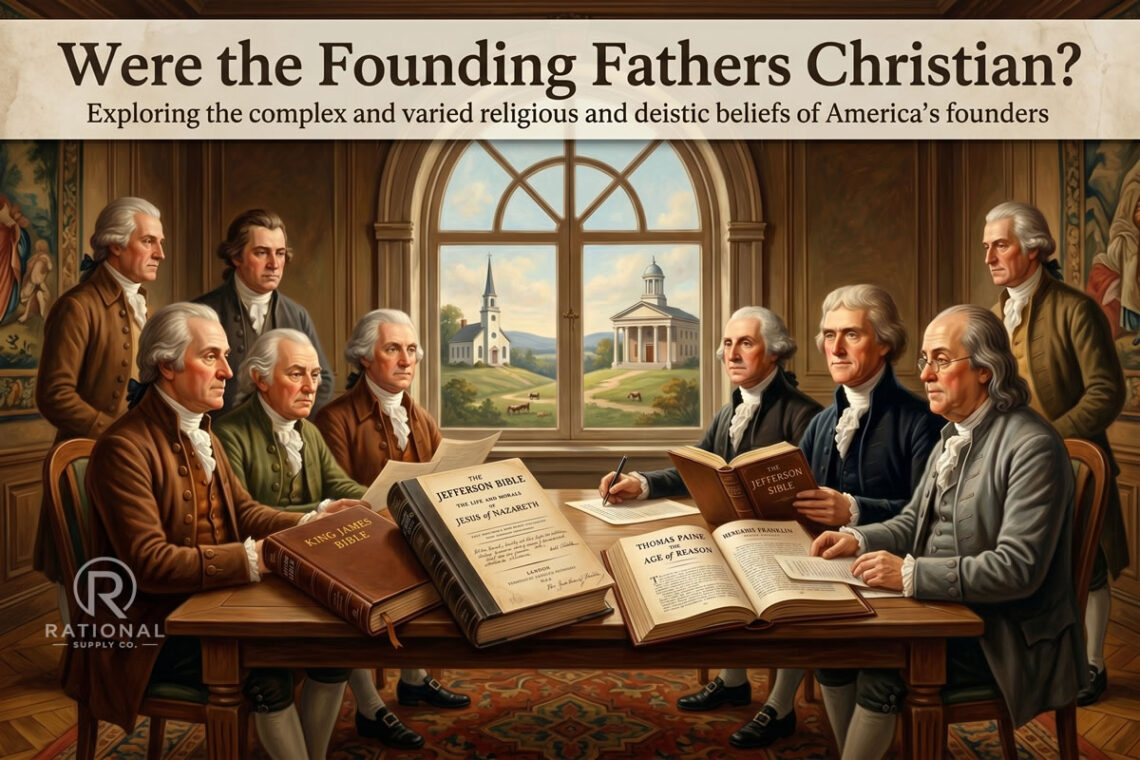
Jefferson was deeply skeptical of organized Christianity, which he regarded as having corrupted the genuine moral teachings of Jesus. He believed Jesus was a great moral philosopher — not the son of God. He literally took a razor to the New Testament, cutting out all references to miracles, the resurrection, and the supernatural, and pasting the remaining passages together into what is now known as the Jefferson Bible. It still exists and is held by the Smithsonian.
Jefferson used the language of deism throughout his writing. He believed in a creator God evident in nature and reason, but not in a personal God who intervened in history. He was privately scornful of the clergy and of religious dogma, though he was careful about what he said in public — he knew his views were politically toxic.
Jefferson also wrote the famous letter to the Danbury Baptist Association in 1802 describing a “wall of separation between church and state” — the phrase that has defined American secularism ever since.
Benjamin Franklin
Franklin was similarly skeptical. He described himself as a deist and was openly doubtful about the core claims of Christianity, including the divinity of Jesus. In his autobiography, written late in life, he acknowledged that he had “some doubts” about Jesus’s divinity and said he saw no harm in not resolving the question before he died.
Franklin was a committed moralist — deeply concerned with how people should live — but he grounded ethics in reason and social utility rather than divine command. He was also, famously, one of the most pragmatic men in American history, and he had little patience for religious enthusiasm or dogma.
John Adams
Adams was a Unitarian — a tradition that explicitly rejected the Trinity, the divinity of Jesus, and many of the supernatural claims of mainstream Christianity. Unitarianism in Adams’s time was essentially Christianity reduced to a moral philosophy and stripped of its miraculous content.
Adams was openly critical of organized religion in his private correspondence, describing what he saw as its long history of manipulation and political abuse. He was particularly sharp on the subject of religious establishments — state-sponsored churches — which he viewed as incompatible with genuine freedom.
Crucially, Adams signed the Treaty of Tripoli in 1797, which stated plainly that “the Government of the United States of America is not, in any sense, founded on the Christian religion.” This was not a throwaway line — it was a formal diplomatic document, ratified unanimously by the Senate, stating the official position of the new republic.
James Madison
Madison is perhaps the most important founder when it comes to the relationship between religion and government, because he was the primary architect of the First Amendment.
Madison believed deeply in the separation of church and state — not as a concession to non-believers, but as a protection for religious believers themselves. He had seen what state-established churches did to religious minorities in Virginia, and he wanted no part of it at the federal level.
Madison’s own religious views were private and somewhat opaque, but historians generally place him in the deist camp. He rarely spoke of personal religious belief and consistently opposed any government entanglement with religion, including congressional chaplains, which he regarded as a constitutional violation.
George Washington
Washington is the most complicated case, and the one most frequently misrepresented in both directions.
Washington attended church regularly and used religious language throughout his public communications — but there are some notable patterns. He almost never mentioned Jesus by name in his public or private writing. He favored deistic language — “Providence,” “the Author of the Universe,” “the Grand Architect” — over explicitly Christian terminology. He consistently left services before communion, which his own pastor found notable enough to mention.
Was Washington a Christian? He performed the social rituals of one. Did he hold orthodox Christian theological beliefs? Almost certainly not in any traditional sense. The honest answer is that Washington was careful never to say, which was itself a kind of statement.
The Founders Who Were Devout Christians
In fairness, it would be misleading to imply all founders were skeptics.
Patrick Henry was a sincere and vocal Christian. Samuel Adams was deeply devout. John Jay, the first Chief Justice, was an orthodox Anglican and a committed believer. Roger Sherman of Connecticut was a Calvinist.
The founders were not a monolith. They represented a wide spectrum of belief — from Jefferson’s razor-wielding skepticism to Henry’s evangelical fervor. What united them was not a shared theology but a shared conviction that the government had no business picking a winner.
“In God We Trust” and “Under God” — Not What You Think
Two of the most common pieces of evidence offered for America’s Christian founding turn out to be 20th-century additions, not original features.
“In God We Trust” did not appear on paper currency until 1957. “Under God” was not part of the Pledge of Allegiance until 1954. Both were added during the Cold War as explicit counterpoints to “godless communism.” They tell us a great deal about the anxieties of the 1950s — and almost nothing about the intentions of the founders.
The original Pledge of Allegiance, written in 1892, contained no mention of God. The Constitution, drafted by the founders themselves, contains no mention of God, Jesus, Christianity, or any religion — except in the First Amendment, where religion is explicitly kept out of government’s reach.
Why It Matters
Understanding the founders’ actual religious views isn’t just an interesting historical footnote. It goes to the heart of one of the most contested questions in American public life: what did the people who built this country intend when they separated church and state?
The answer, based on the evidence, is clear. The most influential founders — Jefferson, Madison, Franklin, Adams — were not orthodox Christians. They were Enlightenment thinkers who believed that reason, not revelation, was the proper basis for government. They built a secular republic deliberately, having watched what religious establishment did to freedom in Europe and in the colonies.
That doesn’t mean religion has no place in American life. The founders were clear that individuals should be free to believe whatever they chose. But it does mean that the idea of America as a specifically Christian nation — one that should be governed by Christian principles or Christian law — is not supported by history.
It’s a myth. A useful one for some, but a myth nonetheless.
Rational Supply Co. makes clothing and gifts for people who like their history straight. Browse our collection for freethinkers, skeptics, and secular humanists.