
If you’ve ever told someone you don’t believe in God, there’s a reasonable chance they’ve hit you with Pascal’s Wager. It goes something like this:
“If God exists and you believe, you go to heaven — infinite reward. If God exists and you don’t believe, you go to hell — infinite loss. If God doesn’t exist and you believe, you’ve lost nothing. So why not just believe? It’s the rational bet.”
It sounds clever. It has the pleasing structure of a logical argument. Blaise Pascal, the 17th-century French mathematician and philosopher who formulated it, was genuinely brilliant. And yet Pascal’s Wager is, on close inspection, a remarkably poor argument. Philosophers have been dismantling it for centuries, and the objections are devastating.
Here are the main ones.
1. Which God, Exactly?
This is the most immediate problem, and it’s fatal on its own.
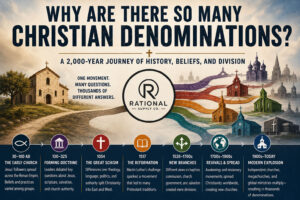
Pascal’s Wager assumes there are only two options: the Christian God exists, or no god exists. But that’s a false binary. There are thousands of religions in the world, each with their own deity or deities, each with their own requirements for salvation or spiritual reward. Christianity itself has almost 50,000 denominations.
What if the correct god is one who rewards sincere skepticism and punishes people who believe out of naked self-interest? What if it’s a god who has nothing but contempt for Pascal’s Wager specifically? What if the Norse gods are real and Valhalla only opens its doors to warriors who died bravely in battle?
Once you acknowledge the full landscape of possible gods — many of whom make mutually exclusive demands — the Wager stops being a clever bet and becomes an impossible one. You can’t hedge against every possible theology simultaneously. The math collapses.
2. You Can’t Just Decide to Believe
Pascal was aware of this objection and tried to answer it, which suggests even he knew it was a real problem.
Belief isn’t a switch you can flip because it’s in your interest to do so. You can’t sincerely believe that the Earth is flat simply because someone offers you a million dollars to believe it. You either find the evidence convincing or you don’t.
Pascal’s own suggested solution was essentially: fake it until you make it. Go to church, perform the rituals, surround yourself with believers, and genuine belief will eventually follow. But this raises an obvious question: would an all-knowing God be fooled by performed belief? A deity capable of judging souls presumably has access to the contents of your mind. Believing strategically — as a calculated bet — is not the same as genuine faith, and most religious traditions are clear that God can tell the difference.
3. The Argument Proves Too Much
One of the classic tests for a logical argument is whether the same structure could be used to prove something absurd. Pascal’s Wager fails this test badly.
The exact same reasoning can be used to justify almost any outlandish belief. What if there’s an invisible dragon who grants eternal bliss to anyone who hops on one foot every Tuesday? The potential reward is infinite, and the cost of hopping is trivial — so by Pascal’s logic, you should hop. Every Tuesday. Just in case.
This is obviously ridiculous. But the structure of the argument is identical to Pascal’s. If infinite reward is enough to justify belief on its own, then we’re obligated to take seriously every conceivable claim of infinite reward, no matter how absurd. That’s not a coherent approach to life or to reasoning.
4. It’s a Deeply Cynical View of Faith
This is less a logical objection than a moral one — but it’s worth raising, especially for an audience that includes many people who were once religious.
Most serious theologians and religious thinkers find Pascal’s Wager embarrassing precisely because it reduces faith to a transaction. It frames belief in God as a self-interested insurance policy rather than a genuine relationship, a real encounter with the divine, or a sincere response to evidence and experience.
C.S. Lewis, one of the most influential Christian apologists of the 20th century, would have had little patience for someone who believed solely to avoid hell. That’s not faith — it’s spiritual risk management. The argument, at its core, treats God as an entity that can be gamed. Most believers find that view more offensive than atheism.
5. The Cost of Belief Isn’t Zero
Pascal assumes that if God doesn’t exist, the believer has “lost nothing.” But that’s not true.
Belief has real costs. It can mean organizing your life around a set of claims that aren’t true — shaping your ethics, your relationships, your politics, and your sense of self around a false premise. It can mean spending time, energy, and money on religious practice. It can mean accepting moral frameworks that cause real harm — to women, to LGBTQ+ people, to those of other faiths.
A life lived honestly, in pursuit of what is actually true, has value. Wagering that away isn’t “nothing.” It’s significant.
The Bigger Picture
Pascal’s Wager is a useful thing to understand, not because it’s a good argument, but because it reveals something important: even its defenders sense that the positive case for belief is weak. When the best argument on offer is “you might as well — what have you got to lose?”, that’s not a ringing endorsement of the underlying claim.
Freethinkers, skeptics, and secular humanists don’t reject belief because they’ve failed to hear Pascal’s argument. They reject it because they’ve thought it through — and found it wanting.
That, in the end, is exactly the point.
At Rational Supply Co., we make clothing and gifts for people who’ve done the thinking. Browse our collection for freethinkers, skeptics, and secular humanists.