
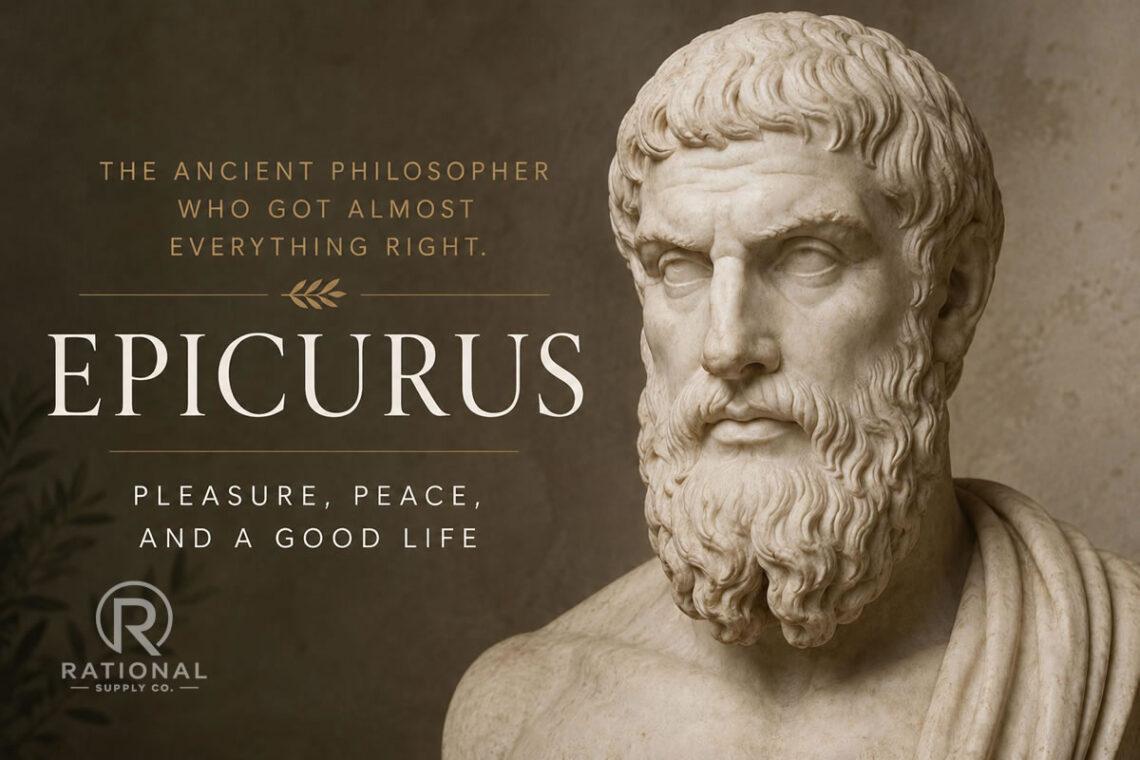
About 2,300 years ago, a Greek philosopher set up a small community outside Athens, invited women and slaves to join as equals, taught that the gods had no interest in human affairs, argued that death was nothing to fear, and insisted that the good life was available to anyone willing to think clearly and live simply.
His name was Epicurus. He was, in many ways, the world’s first secular humanist — and his ideas are more relevant today than most people realize.
Who Was Epicurus?
Epicurus was born in 341 BCE on the Greek island of Samos. He founded his own school of philosophy in Athens around 307 BCE, centered on a property known simply as “the Garden.” Unlike the elite academies of Plato and Aristotle, the Garden was open to people typically excluded from intellectual life — women, slaves, and foreigners. For ancient Athens, this was radical.
Epicurus was enormously prolific, reportedly writing hundreds of works. Almost none of them survived. What we know of his philosophy comes largely through later writers — most importantly the Roman poet Lucretius, whose stunning philosophical poem De Rerum Natura (“On the Nature of Things”) transmitted Epicurean ideas to the Roman world and, eventually, to us.
What Did Epicurus Actually Believe?
Here’s where the popular understanding goes badly wrong.
Most people today associate “Epicurean” with fine dining, luxury, and sensual indulgence. This is almost the exact opposite of what Epicurus taught. He lived simply, ate bread and water, and wrote that a pot of cheese felt like a feast. His philosophy of pleasure was deeply misunderstood by his critics and has been misrepresented ever since.
What Epicurus actually believed:
The goal of life is happiness — but happiness is tranquility, not thrill. Epicurus distinguished between two kinds of pleasure: kinetic pleasures (active, stimulating — a great meal, a party) and katastematic pleasures (stable, enduring — the absence of pain, the presence of peace). He was much more interested in the second kind. The highest human happiness, for Epicurus, was ataraxia — a Greek word meaning something like undisturbed tranquility.
The greatest pleasures are simple and free. Friendship, philosophical conversation, rest, and freedom from anxiety. Epicurus thought the pursuit of wealth, fame, and power was a trap — those things create more anxiety than they relieve.
Friendship is the most important thing in life. Epicurus wrote that of all the things wisdom provides for a happy life, the greatest by far is friendship. The Garden community was built around this idea — a group of people committed to living and thinking well together.
Epicurus on the Gods
Here’s where secular humanists will find Epicurus most interesting.
Epicurus didn’t deny the existence of gods. But he argued forcefully that the gods had absolutely no interest in human affairs. They did not create the world, they did not intervene in it, they did not reward virtue or punish sin, and they were entirely indifferent to prayer. The gods, if they existed, lived in perfect bliss somewhere beyond our world and had better things to do than manage human lives.
The practical implication was enormous: if the gods don’t care about us, then religion-based fear is irrational. There is no divine punishment to dread, no cosmic judgment to worry about, no supernatural force manipulating your fate. You are free — and responsible — to figure out how to live well entirely on your own terms.
This was not a safe position to hold in ancient Athens. Epicurus was accused of impiety throughout his life. He didn’t care. He thought the fear of divine punishment was one of the primary sources of human misery, and he made it his business to dismantle it.
Epicurus on Death
This is the idea Epicurus is most famous for among philosophers, and it’s devastating in its simplicity.
The fear of death, he argued, is irrational — because death is not an experience. When you are dead, you do not exist. You cannot suffer, feel regret, or experience loss. There is no “you” to be harmed by death.
He put it this way: “When death is, I am not; when I am, death is not.”
Before you were born, you did not exist — and that caused you no distress. Death is simply a return to the same state. The time before your birth was not a horror, and the time after your death will not be either.
This is not merely wordplay. It’s a serious philosophical argument that has comforted skeptics and freethinkers for more than two thousand years. It’s also, not coincidentally, entirely compatible with everything modern science tells us about consciousness and mortality.
Epicurus and the Problem of Evil
One of the most famous arguments against the existence of a benevolent God is often attributed to Epicurus, though historians note the precise formulation we know today was recorded by later writers. The argument runs roughly like this:
If God is willing to prevent evil but not able, then he is not omnipotent. If he is able but not willing, then he is malevolent. If he is both willing and able, why does evil exist? If he is neither willing nor able, why call him God?
Whether or not Epicurus worded it exactly this way, the argument is thoroughly Epicurean in spirit — applying cold logic to the claims of religion and finding them wanting. It remains one of the most powerful challenges to theism ever formulated, and philosophers are still arguing about it today.
Why Epicurus Was Almost Buried by History
For centuries after the fall of Rome, Epicurean philosophy was actively suppressed by the Christian church. The reasons are obvious: a philosophy that denied divine providence, dismissed the fear of death and judgment, and located the good life entirely in this world was a direct challenge to Christian authority.
Epicurus was slandered as a glutton and a hedonist. His books were destroyed. His name became a byword for excess.
The Renaissance and Enlightenment slowly rehabilitated his reputation. Lucretius’s De Rerum Natura — rediscovered in a monastery in 1417 by the humanist scholar Poggio Bracciolini — helped spark the scientific revolution by reviving the ancient Greek theory of atoms. Thomas Jefferson admired Epicurus deeply and described himself as “an Epicurean.” Karl Marx wrote his doctoral dissertation on Epicurean philosophy.
Today, Epicurus is recognized as one of the most original and consequential thinkers in Western history — a man who worked out the essentials of secular, reason-based living more than three centuries before the birth of Christianity.
What Epicurus Got Right
Nearly everything that secular humanists value today, Epicurus articulated first:
- Live according to reason, not tradition or superstition
- The good life is available here and now, without supernatural assistance
- Fear of death is irrational and robs us of peace
- Friendship and community are central to human flourishing
- Simple living and clear thinking beat wealth and ambition
- The gods — if they exist — are not concerned with us
He got a few things wrong. His political quietism — his advice to withdraw from public life — sits uneasily with modern humanist commitments to democracy and social justice. And his philosophy, focused almost entirely on personal tranquility, doesn’t have much to say about structural injustice or collective responsibility.
But for a man working without the benefit of modern science, democratic theory, or two thousand years of moral philosophy — he came remarkably close.
Rational Supply Co. makes clothing and gifts for people who’ve been thinking along these lines for a while — whether they knew Epicurus’s name or not.